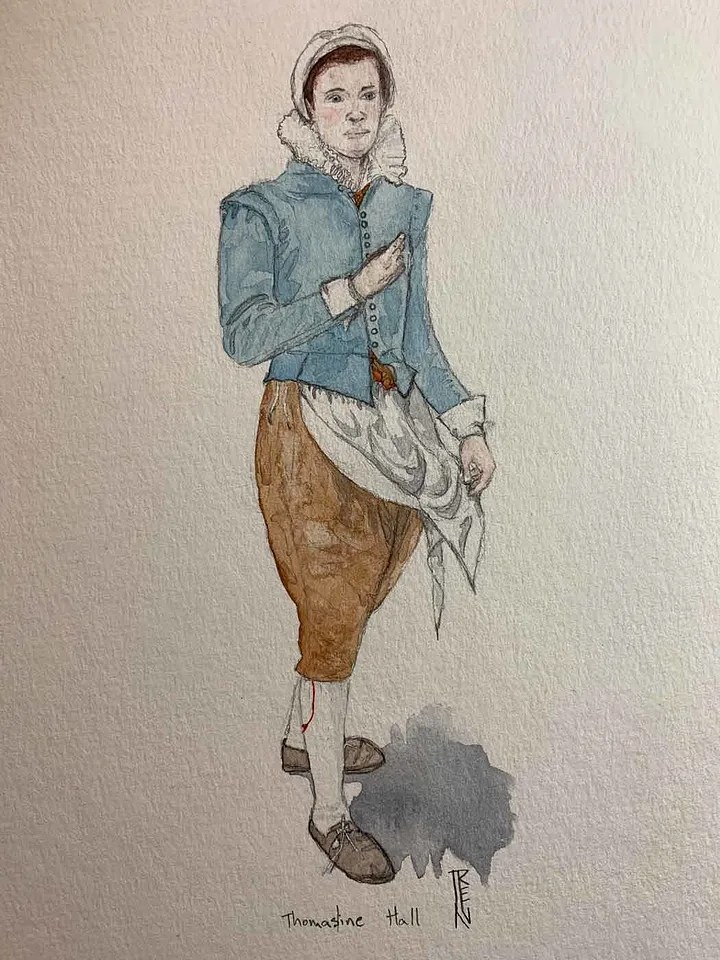
Though some would pretend that American history is made up solely of brave men and women who furthered the American Dream, scholars have recently uncovered stories of those who did not identify as entirely male or female in Colonial America. One such person is Thomas(ine) Hall.
To be clear for this posting, a person who is intersex is someone born with both male and female biological traits. For the clarity of the individual being discussed here, I will use the pronouns “they/them” to describe Thomas(ine) Hall. You’ll see in a moment why the parentheses are used.
Born around the year 1600 in Newcastle-upon-Tyne, England, Thomas(ine) was born to a working-class family and raised as a woman, despite having some male biological traits. Though raised to perform the roles and duties ascribed to English women of their station, Thomas(ine) joined the English Army at the age of 24 after their brother was drafted, disguising themselves by cutting their hair and wearing “traditional” men’s clothing. They served their country well, but after their service, they chose to identify as a woman once again.
This all changed, however, in 1627, when they decided to start life anew in the British colony of Virginia as an indentured servant.
Once in Virginia, they identified and bore the duties traditionally ascribed to men on a tobacco plantation near Jamestown, though they later changed course and (on the same plantation and without not so much as a stern look from the plantation owner, John Tyos) transitioned to performing the duties traditionally doled out to indentured women on the same plantation.
Though their boss swore that Thomas(ine) was female when the change occurred, this drew the ire of the community at large as they dressed and identified as either gender interchangeably. When asked by townsfolk which sex they were, Thomas(ine) allegedly stated that they were both.
Humiliation ensued when the community at large demanded an examination of Thomas(ine) to determine what genitals they had to “determine” their sex. Upon multiple investigations, the townsfolk were continually stumped. Some said this individual was Thomas, while others maintained the individual was Thomasine. No one could definitively state whether Thomas(ine) was male or female.
The courts eventually became involved and the judge came to a puzzling final verdict – that Thomas(ine) was to wear pieces of clothing of both genders: the breeches and shirt of a man and the cap and apron of a woman. This was apparently to alert the public that Thomas(ine) had an “unusual status” as both a man and a woman.
There are no further records of Thomas(ine)’s life, yet the matter of a court declaring them both male and female is proof that those who are intersex or even nonbinary have existed for centuries, even in Colonial America.
#LGBTQIA #PrideMonth #YouCannotEraseUs #ThomasineHall
 Legends of Pride